Guide
How to design your own trading card game
A trading card game is a small set of rules and a large set of cards that bend them. Here's how to design one, from the first idea to a deck you can shuffle.
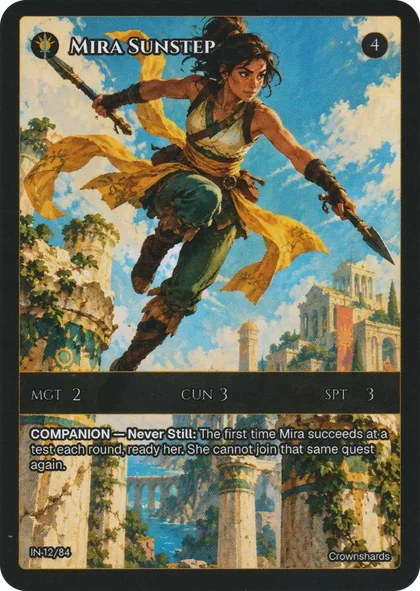
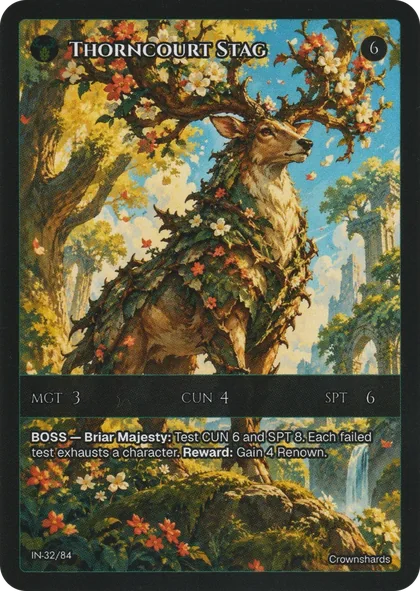
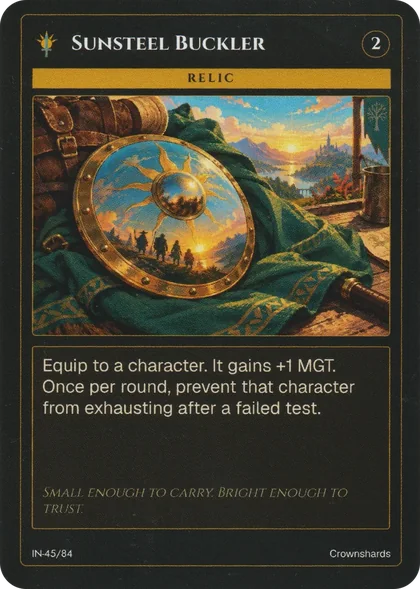
1. Start with a theme and one core idea
Every good card game can be described in a sentence. Rival wizards summon elemental beasts. Deep-sea explorers race to map the ocean floor. Your kid's monsters fight for the title of Biggest Monster.
The theme is the world the cards live in. The core idea is the one thing that makes your game feel different from the others. It might be a twist on combat, like creatures that grow stronger each turn they survive. It might be a twist on resources, like spending cards from your hand instead of energy. Pick one. A game with five clever ideas is usually harder to learn and less fun than a game with one.
Write both down before you design any cards. Every card you make later should fit the theme and lean on the core idea.
2. Decide how you win and how a turn works
The win condition is what every card ultimately serves. The common ones are:
- Reduce a life total to zero. Simple, familiar, and it gives every attack a clear purpose.
- Collect points or prizes. Win by defeating a set number of the other player's creatures, or by scoring.
- Complete a goal. Control three locations, assemble a set, or survive a number of rounds.
Then write the turn as a short list of steps. For example: draw a card, gain resources, play cards, attack, end the turn. Keep it to four or five steps. If you need a paragraph to explain a turn, players will forget a step.
Decide the starting setup too: how many cards each player draws, what their life total or goal is, and who goes first. Going first is usually an advantage, so many games have the first player skip their first draw or attack.
3. Choose a resource system
Resources stop players from playing their best cards on turn one. They create the pacing of the game: small plays early, big ones later.
- Growing energy. You get one more energy each turn. Easy to learn, and every game ramps up at the same speed.
- Resource cards. Players put special cards into play to produce resources. More strategic, but a hand with too many or too few of them can lose a game on its own.
- Spending cards. Discard cards from your hand to pay for others. Every card becomes a choice between playing it and spending it.
Whatever you choose, give each card a cost in that resource and think about your cost curve: how many cards there are at each cost. A deck needs plenty of cheap cards to play early, a solid middle, and a few expensive cards that feel like an event when they land.
4. Define your card types
Card types are the categories of card in your game, each with its own rules and its own layout. Most games start with a few of these:
- Creatures or units. They stay in play, attack and defend. They usually have attack and health, or power and toughness.
- Spells or actions. They do something once and are discarded: deal damage, draw cards, or change the board.
- Items or equipment. They attach to a creature or stay in play and give a lasting bonus.
- Locations. A shared or personal place in play that changes the rules while it's there.
Two or three types are plenty for a first version. Each new type adds rules to learn and a new layout to design.
This is also where a design tool earns its keep. In ShufflePrints, each card type is a layout of its own, and every card of that type shares it. Describe your game to the assistant and it drafts the types, lays them out, and fills in the first cards, so you can see the game on cards early instead of in a spreadsheet.
5. Lay out the card
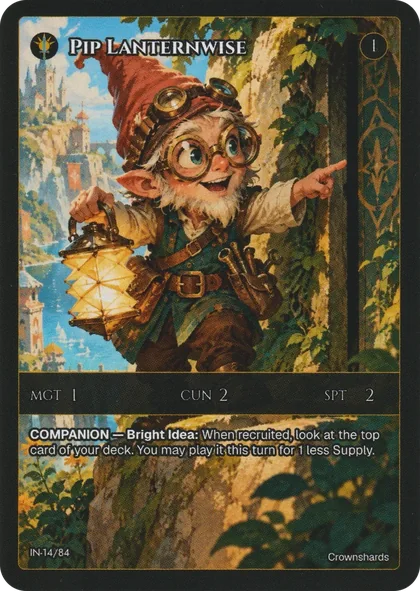
Players read the same parts of a card hundreds of times. Put each in the same place on every card of a type:
- Name. At the top, large enough to read across a table.
- Cost. In a corner, where it can be seen in a fanned hand.
- Art. The biggest area. It's what people remember.
- Type line. What kind of card it is, and any subtype: "Creature — Flame Beast".
- Rules text. What the card does.
- Stats. Attack, health or power, near the bottom in a corner.
- Rarity mark and set number. Small, but useful for collecting and sorting.
Most trading cards are 2.5 × 3.5 inches. Using that size means your cards fit the sleeves, binders and deck boxes players already own. If you want art that runs to the edge of the card, read about bleed and safe zones first.
6. Write keywords and short rules text
Rules text is where new players get lost. Keep it short: two lines is good, four is a lot. If a card needs a paragraph, it's probably two cards, or an idea that should be a keyword.
A keyword is one word that stands for a rule you use often. "Swift: this creature can attack the turn it's played." Once players learn it, every card with Swift is instantly readable. Aim for a handful of keywords, each tied to your theme. Explain them in your rulebook, and for the first printing, in small reminder text on the card.
Write rules text consistently. Always say "deal 2 damage", never sometimes "do 2 damage". Always use the same order: when it happens, then what happens. Consistent wording makes cards faster to read and settles arguments before they start.
7. Balance costs against power
Balance is about making every card worth considering. A card that's always the best choice makes the rest pointless. A card that's never worth playing is wasted space.
Start with a few plain reference cards. For example, a creature costing 2 with 2 attack and 2 health. Then price everything else against them. Give effects a rough value: one point of damage, one card drawn, one extra point of health. A creature with a useful ability should have slightly lower stats than a plain one of the same cost.
Expect your first numbers to be wrong. That's what playtesting is for. As you play, note which cards win games, which are in every deck, and which nobody picks up. Change costs and stats one step at a time and test again. Small changes are easier to judge than big ones.
8. Set deck size and copy limits
Decide how big a player's deck is and how many copies of one card it can hold. Smaller decks make games more consistent. Larger decks make them more varied. Many games use 40 to 60 cards with a limit of three or four copies of any card.
For a first version, skip deck building entirely. Make two fixed decks of 30 to 40 cards, one for each player, with clearly different styles. You'll learn far more from playing two decks a dozen times than from designing two hundred cards that never get played.
9. Add rarity and booster packs
Rarity is what turns a card game into a trading card game. Mark each card common, uncommon or rare, and print fewer of the rare ones. Rare cards should be exciting and interesting, not simply stronger, or the player with more packs always wins.
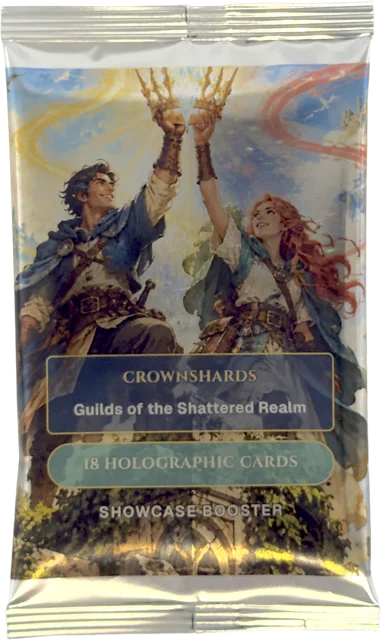
Packs are where rarity comes alive. Opening a sealed pack and finding a shiny card is a large part of the fun, even among friends. When you print, you can pack cards in sealed 18-card foil packs, and give a deck holographic fronts.
10. Keep the art consistent
Art sells a card game before anyone reads a rule. But the most important thing about the art isn't how polished it is. It's that it all looks like it belongs in the same world.
- Choose one style and stick to it: watercolor, pixel art, bold comic, or a child's crayon drawings.
- Use a small color palette, and give each faction or element its own color.
- Keep the framing consistent. Creatures centered, facing the same way, at a similar scale.
If you don't draw, you can describe the style once and have the ShufflePrints assistant make pictures for every card in it. If you do draw, scan or photograph your work and use it as it is.
11. Playtest, then print
Playtesting is where a card game is really designed. Plan on many rounds.
- Paper first. Write the earliest cards on index cards or slips of paper slid into card sleeves in front of old cards. They're quick to change, and you'll change them a lot.
- Play yourself, then with others. Play both sides alone to find the obvious problems. Then teach it to someone and watch, without explaining. Where they get confused is where your rules need work.
- Keep notes. After each game, write down who won, how long it took, and any card that felt too strong, too weak or confusing.
- Print a real deck. Once the cards stop changing every game, print them properly. Real cards shuffle, sleeve and feel like a game, and playtesters take them more seriously. It's also the moment the game starts to feel real to you.
On ShufflePrints, the Standard card stock is smooth and about as thick as Pokémon or Magic cards. You can print a single deck, and when you change a card, you can order the new version. More on printing your own card game.
12. Make it your own
It's fine to be inspired by the games you love. Basic mechanics like drawing cards, spending energy or attacking with creatures are common to most card games and aren't protected, so they're open to everyone. So are the basic parts of a card: a name, a cost, art, a type line, rules text and stats. What is protected is the way other games express those ideas: their names, logos, set symbols, mana or energy symbols, card backs, art and rules text.
So write your own rules text in your own words, draw your own symbols, design your own card back, and give your game its own name. Besides keeping you clear of problems, it makes a better game. ShufflePrints only prints original cards you have the right to print.
Questions
How many cards do I need to make a trading card game?
Fewer than you think. A first playable version can be two decks of 30 to 40 cards each, built from 20 to 30 different cards. Add more once the core game is fun.
Can I use mechanics from Magic or Pokémon?
Basic mechanics like drawing cards, spending energy, tapping or attacking are common to many games and aren't protected, so they're free to use. What's protected is how a particular game expresses them: its name, logos, symbols, card backs, art and rules text. Write your own words, draw your own symbols and make the game your own.
How do I balance card costs?
Give every effect a rough value, set each card's cost to match, and pick a few plain cards as your reference point. Then playtest: track which cards win games and which never get played, and adjust their costs one step at a time.
How do I print my own trading card game?
Playtest early versions on paper. When the cards are settled, print a real deck at the standard 2.5 by 3.5 inch size so it fits ordinary sleeves. ShufflePrints prints custom decks with holographic fronts, in tuck boxes or sealed 18-card foil packs.
What size are trading cards?
Most trading card games use 2.5 by 3.5 inch cards, the same size as standard playing cards. Using that size means your cards fit the sleeves, binders and deck boxes players already own.